If you are looking for a simple, safe and completely free way to enjoy movies and series on your cell phone, tablet or TV, Tubi – Free Movies and Series stands out as one of the best options available in 2026. With an impressive collection, a clean interface, and support for Portuguese subtitles, the app offers access to thousands of titles free of charge. And best of all, it's available for direct download from the official stores:

Tubi: Free Movies & Live TV
AI in Industrial Machinery: 15 Ways Smart Machines Will Transform Manufacturing in 2027
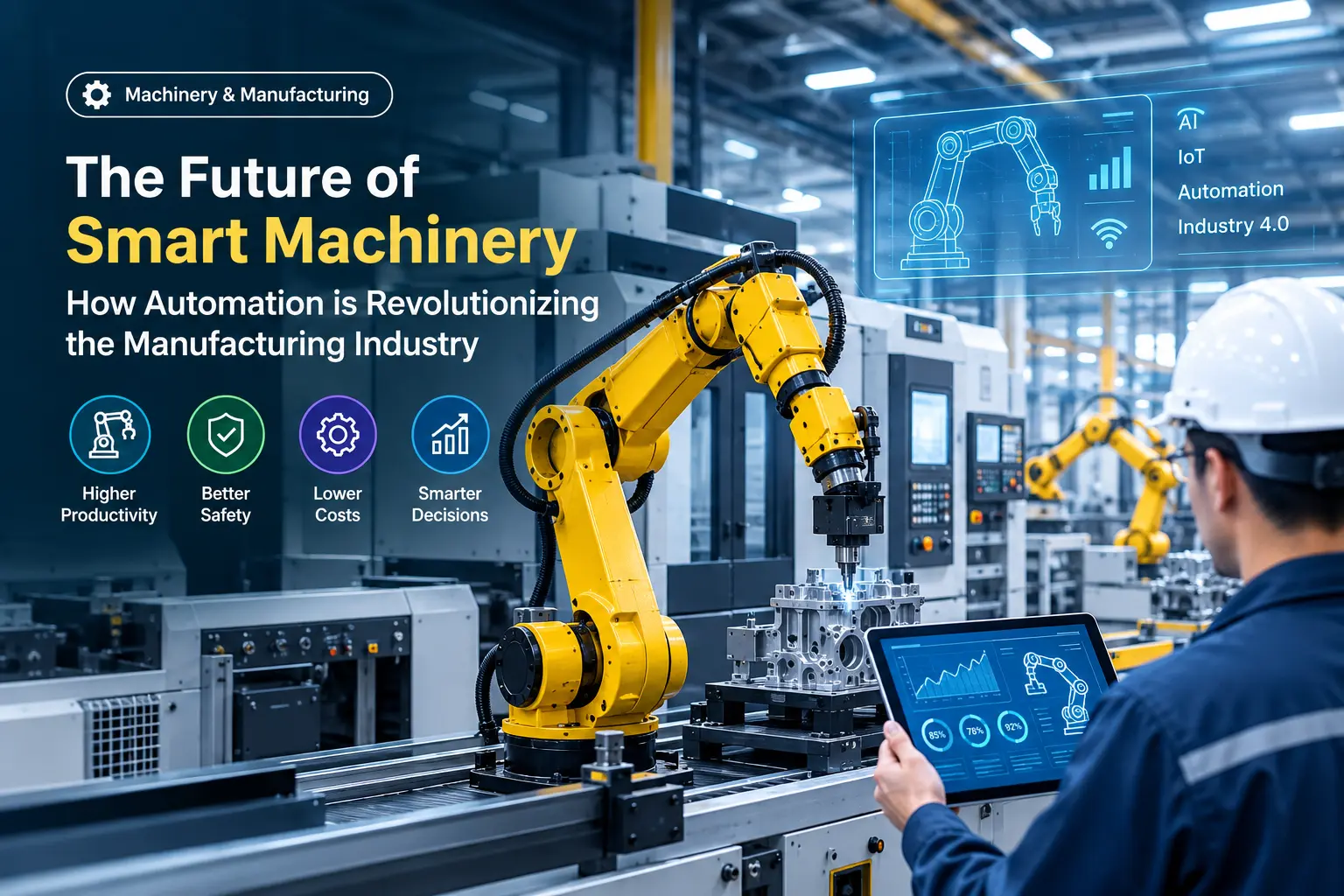
Manufacturing is in the middle of the biggest technological shift since the introduction of the assembly line, and artificial intelligence is the driving force behind it. Factories that once relied on scheduled maintenance, manual inspection, and static production lines are rapidly turning into connected, self-optimizing environments. Industrial machinery embedded with sensors, machine learning models, and real-time analytics engines can now predict failures before they happen, adjust production on the fly, and communicate directly with enterprise resource planning and supply chain systems.
By 2027, industry analysts expect the vast majority of mid-size and large manufacturing plants worldwide to have deployed at least one form of AI-driven automation, whether that is a predictive maintenance platform, a computer vision quality control system, or a fully autonomous mobile robot fleet. This shift is not just about cutting costs. It is about survival in a market where labor shortages, rising energy prices, and increasingly complex global supply chains punish any operation that clings to outdated, reactive processes.
In this guide, we break down fifteen concrete ways smart machines and industrial AI software are set to transform manufacturing floors in 2027, along with the underlying technologies, the real business impact, the challenges manufacturers still need to solve, and a practical roadmap for getting started.
Why AI Is Becoming the New Backbone of Industrial Machinery
Traditional industrial equipment was built to perform a fixed task reliably and repeatedly. The machine did not know its own condition beyond a handful of gauges, and it certainly did not communicate with other machines on the floor. That model worked when production runs were long, product variety was low, and downtime could be absorbed with buffer inventory.
Modern manufacturing looks nothing like that. Product lifecycles are shorter, customization is expected, energy and raw material costs fluctuate constantly, and customers demand faster delivery. Machinery now needs to be aware of its own performance, capable of adjusting itself, and able to share data across the entire operation. That is exactly what artificial intelligence, industrial Internet of Things sensors, and edge computing bring to the table. Machines equipped with these technologies do not just execute instructions; they learn from historical performance, detect anomalies invisible to the human eye, and recommend or trigger corrective action long before a costly breakdown occurs.
15 Ways Smart Machines Will Transform Manufacturing in 2027
1. Predictive Maintenance Powered by Machine Learning
Predictive maintenance software is arguably the single most valuable application of AI in industrial machinery today. Instead of servicing equipment on a fixed calendar schedule or waiting for it to fail, machine learning models continuously analyze vibration data, temperature readings, acoustic signatures, and electrical current patterns collected from sensors attached to motors, pumps, bearings, and gearboxes. These models learn what 'normal' operation looks like for each specific asset and flag subtle deviations that indicate developing faults, often weeks before a human technician would notice anything wrong. By 2027, predictive maintenance platforms will be standard equipment on new industrial machinery, not an aftermarket add-on, and they will integrate directly with computerized maintenance management systems to automatically schedule repairs during planned downtime windows.
2. Computer Vision for Automated Quality Control
High-resolution cameras combined with deep learning image recognition models are replacing manual visual inspection on production lines. These AI quality control systems can detect micro-cracks, surface defects, dimensional inconsistencies, and assembly errors at speeds and accuracy levels no human inspector can match, often processing hundreds of units per minute. Because the models continuously retrain on new defect examples, detection accuracy keeps improving over time. In 2027, expect computer vision inspection to become the default final checkpoint across automotive, electronics, and packaged goods manufacturing, dramatically reducing warranty claims and recall costs.
3. Digital Twins for Virtual Process Simulation
A digital twin is a live, continuously updated virtual replica of a physical machine, production line, or entire factory. Engineers can simulate changes such as a new product configuration, a different raw material, or an altered line speed inside the digital twin before touching the physical equipment, eliminating costly trial-and-error on the real floor. Digital twin technology also allows remote teams to diagnose issues on machinery located anywhere in the world without physically traveling to the site. As digital twin platforms become more affordable and easier to deploy, they will move from being a large-enterprise luxury to a standard tool used even by mid-size manufacturers by 2027.
4. Autonomous Mobile Robots and Smart Material Handling
Autonomous mobile robots equipped with AI-based navigation are taking over material transport tasks that used to require forklift operators and fixed conveyor infrastructure. These robots use simultaneous localization and mapping technology to navigate dynamically around obstacles, coordinate with each other to avoid collisions, and reroute instantly when a path is blocked. Combined with warehouse and production management software, fleets of these robots can rebalance inventory, feed assembly stations just-in-time, and adapt instantly when a production schedule changes, something fixed conveyor systems simply cannot do.
5. AI-Optimized Energy Management on the Factory Floor
Energy costs are one of the largest controllable expenses in heavy manufacturing, and AI-driven energy management systems are becoming essential for controlling them. These systems analyze real-time consumption data from every major piece of equipment, forecast demand based on production schedules, and automatically shift non-critical loads to off-peak periods or renewable energy availability windows. Some advanced systems even negotiate directly with utility demand-response programs. As energy prices remain volatile heading into 2027, manufacturers using AI-based energy optimization will hold a meaningful cost advantage over competitors still running equipment on fixed schedules.
6. Generative AI for Production Planning and Scheduling
Generative AI models are increasingly being applied to production scheduling, a problem that has always been mathematically complex because of the sheer number of variables involved: machine availability, labor shifts, material lead times, order priorities, and maintenance windows. Instead of relying on rigid rule-based schedulers, generative AI planning tools can rapidly propose and evaluate thousands of scheduling scenarios, recommending the sequence that minimizes changeover time, balances workload, and meets delivery commitments. Plant managers can also query these systems in plain language, asking questions like 'what happens to our delivery dates if line two goes down for four hours' and get an instant, data-backed answer.
7. Collaborative Robots (Cobots) Working Safely Alongside Humans
Unlike traditional industrial robots that operate behind safety cages, collaborative robots are designed with force-limiting sensors and AI-driven motion planning that allow them to work directly alongside human operators. Cobots handle repetitive, ergonomically taxing tasks such as screw driving, parts feeding, and heavy lifting, freeing human workers for tasks that require judgment and dexterity. As AI perception improves, cobots in 2027 will be able to adapt to variation in part placement and human movement in real time, making them practical for small-batch and highly customized production runs where traditional automation was never cost-effective.
8. AI-Driven Supply Chain and Demand Forecasting
Manufacturing machinery does not operate in isolation from the supply chain, and AI-powered demand forecasting software is closing the gap between production capacity and actual market demand. These platforms ingest historical sales data, macroeconomic indicators, weather patterns, and even social media sentiment to generate far more accurate demand forecasts than traditional statistical models. That forecast then flows directly into machine scheduling, so equipment is producing the right products in the right quantities at the right time, reducing both stockouts and excess inventory sitting on the warehouse floor.
9. Self-Optimizing CNC Machines and Adaptive Machining
AI-powered CNC machines are now capable of adjusting cutting speed, feed rate, and tool path in real time based on sensor feedback about material hardness, tool wear, and vibration. This adaptive machining approach extends tool life, reduces scrap, and maintains tighter tolerances than static, pre-programmed toolpaths ever could. Some next-generation CNC systems use reinforcement learning to continuously refine their own machining parameters across thousands of production cycles, effectively getting better at their job the longer they run.
10. Natural Language Interfaces for Machine Operators
Operating complex industrial machinery has traditionally required extensive training on proprietary control interfaces. Large language models are now being embedded directly into machine human-machine interfaces, allowing operators to ask questions or issue commands in plain language, such as 'show me why line three's output dropped this morning' or 'walk me through the changeover procedure for this mold.' This dramatically shortens onboarding time for new operators and reduces the operational knowledge lost when experienced staff retire, a growing concern given the manufacturing skills gap.
11. AI-Powered Cybersecurity for Connected Industrial Equipment
As more industrial machinery connects to networks and cloud platforms, it becomes a bigger target for cyberattacks, and traditional IT security tools were never designed for operational technology environments. AI-based industrial cybersecurity platforms continuously monitor network traffic between programmable logic controllers, sensors, and enterprise systems, learning normal communication patterns and instantly flagging anomalies that could indicate a breach or ransomware attempt. Given the rising frequency of attacks specifically targeting manufacturing operational technology, this category of software is becoming a board-level priority heading into 2027.
12. Machine-Level Digital Assistants for Root Cause Analysis
When a production line goes down, every minute of diagnostic time is lost output. AI-driven root cause analysis tools correlate sensor data, maintenance logs, and historical failure records across an entire fleet of machines to pinpoint the likely cause of a fault within seconds rather than the hours it might take an engineer working manually. These systems also build institutional knowledge over time, meaning the diagnostic process gets faster and more accurate the longer the platform is in use.
13. AI-Enhanced Additive Manufacturing and 3D Printing
Industrial 3D printing is being transformed by AI models that optimize part geometry for strength and material efficiency, predict print failures before they happen by monitoring thermal imaging during the build, and automatically adjust print parameters layer by layer. This is pushing additive manufacturing beyond prototyping into full production of end-use parts, particularly in aerospace, medical devices, and tooling, where AI-optimized lattice structures can cut material weight significantly while maintaining structural integrity.
14. Sustainability and Emissions Tracking Built Into Machinery
Regulatory pressure and customer demand for verified sustainability data are pushing manufacturers to track emissions and resource consumption at the individual machine level, not just at the facility level. AI-powered sustainability platforms aggregate data directly from machine controllers to calculate real-time carbon footprint, water usage, and waste generation per unit produced, automatically generating the reports required for environmental compliance and corporate sustainability disclosures. This granular, machine-level visibility is becoming a competitive differentiator for manufacturers selling into markets with strict environmental reporting requirements.
15. Autonomous, Lights-Out Production Cells
The combination of every technology above is enabling something that was science fiction a decade ago: fully autonomous 'lights-out' production cells that can run unattended overnight and on weekends. These cells combine AI-driven scheduling, computer vision quality checks, predictive maintenance, and autonomous material handling into a closed loop that requires human intervention only for exceptions. While fully lights-out entire factories remain rare, isolated lights-out cells for specific high-volume, well-characterized processes are expected to become increasingly common in 2027 as manufacturers look to squeeze more output from existing capital equipment without adding headcount.
Traditional Manufacturing vs. AI-Driven Smart Manufacturing
| Aspect | Traditional Manufacturing | AI-Driven Smart Manufacturing (2027) |
|---|---|---|
| Maintenance Approach | Scheduled or reactive maintenance | Predictive maintenance based on real-time sensor data |
| Quality Control | Manual visual inspection, sampling-based | 100% automated computer vision inspection |
| Production Scheduling | Static, rule-based schedules | Dynamic, AI-generated schedules updated in real time |
| Material Handling | Fixed conveyors and manual forklifts | Autonomous mobile robots with dynamic routing |
| Energy Usage | Fixed operating schedules regardless of cost | AI-optimized load shifting and demand response |
| Fault Diagnosis | Manual troubleshooting, hours of downtime | Automated root cause analysis in seconds |
| Operator Training | Long onboarding on proprietary interfaces | Natural language assistants reduce ramp-up time |
Key Technologies Powering This Transformation
Several underlying technology layers are converging to make all fifteen of these applications possible at scale. Industrial IoT sensors provide the raw data stream from machinery. Edge computing devices process time-sensitive data directly on the factory floor, reducing latency and bandwidth costs compared to sending everything to the cloud. Cloud-based AI platforms handle the heavier model training and cross-facility analytics. Manufacturing execution systems and enterprise resource planning software act as the connective tissue that turns machine-level insight into business decisions. And increasingly, 5G private networks are providing the reliable, high-bandwidth wireless connectivity that mobile robots and wireless sensors require on the plant floor. Manufacturers evaluating vendors in 2027 should look closely at how well these layers integrate with each other rather than adopting isolated point solutions that cannot share data.
Challenges Manufacturers Still Need to Solve
Despite the clear momentum, adopting AI in industrial machinery is not without obstacles. Legacy equipment on many factory floors was never designed to be networked, requiring costly retrofits or full replacement before it can participate in a smart factory ecosystem. Data quality remains a persistent issue, since AI models are only as good as the sensor data feeding them, and poorly calibrated or intermittent sensors can produce misleading predictions. There is also a well-documented skills gap: plants need employees who understand both traditional mechanical and electrical systems and modern data science concepts, a combination that is currently in short supply. Finally, cybersecurity concerns cannot be an afterthought, since connecting previously isolated operational technology to broader networks expands the attack surface considerably. Successful adopters in 2027 will be the manufacturers who treat these challenges as part of the implementation plan from day one, rather than issues to solve after deployment.
How Manufacturers Can Prepare for 2027
Organizations that want to capture the benefits of AI-driven industrial machinery should start with a focused pilot rather than an all-at-once overhaul. Identifying one high-value, well-understood process, such as predictive maintenance on a critical bottleneck machine, allows a team to prove return on investment and build internal expertise before scaling further. Investing in a solid industrial data infrastructure, including reliable sensors and a unified data platform, pays dividends across every future AI initiative rather than locking a plant into a single vendor's ecosystem. Cross-training maintenance and operations staff in basic data literacy will also matter more than hiring a handful of specialized data scientists, since the people closest to the machines are often best positioned to interpret AI-generated recommendations correctly. Finally, building a clear cybersecurity framework for any newly connected equipment should happen in parallel with, not after, automation upgrades.
Real-World ROI: What Early Adopters Are Reporting
Manufacturers who have already rolled out predictive maintenance, computer vision inspection, or AI-driven scheduling are not just chasing a trend; many are reporting measurable financial returns within the first year of deployment. Reductions in unplanned downtime are consistently among the most cited benefits, since even a single avoided line stoppage on a high-volume production line can offset the cost of an entire sensor and software rollout. Scrap and rework rates also tend to fall noticeably once computer vision inspection replaces manual sampling, because defects are caught at the exact station where they occur rather than several steps downstream where the cost of correction is far higher. Energy bills are another area where AI-driven optimization shows up quickly on the balance sheet, particularly in energy-intensive processes like injection molding, metal casting, and industrial ovens where load shifting can meaningfully lower peak demand charges.
It is worth noting that the return on investment is rarely immediate on day one. Most successful deployments follow a similar curve: an initial data collection and model training period of several weeks to a few months, followed by a steady improvement in prediction accuracy and recommendation quality as the system accumulates more operating history. Manufacturers that treat the first quarter of any AI deployment as a calibration phase, rather than expecting instant transformation, tend to see far better long-term outcomes and stronger buy-in from plant floor staff who might otherwise be skeptical of a new system.
Frequently Asked Questions
What industries will benefit most from AI in industrial machinery in 2027?
Automotive, electronics, food and beverage, pharmaceuticals, and heavy equipment manufacturing are expected to see the fastest adoption, largely because these industries already run high-volume, capital-intensive production lines where even small efficiency gains translate into large financial returns.
Is predictive maintenance software expensive to implement?
Costs vary widely depending on the number of machines and sensors involved, but many vendors now offer subscription-based pricing that lowers the upfront investment considerably compared to a few years ago, making predictive maintenance accessible even to smaller manufacturers.
Will AI and robotics replace factory workers entirely?
Most industry research points to AI and robotics changing the nature of factory jobs rather than eliminating them outright, shifting demand toward roles focused on overseeing, maintaining, and interpreting the output of automated systems rather than performing repetitive manual tasks.
What is the difference between a digital twin and a simulation?
A traditional simulation is typically a one-time or periodic model used for planning, while a digital twin is continuously synchronized with live data from the physical asset, meaning it reflects the equipment's actual current condition rather than a static assumption.
How does AI improve energy efficiency on the factory floor?
AI energy management systems analyze consumption patterns across every connected machine and automatically adjust operating schedules, standby modes, and load distribution to minimize costs and reduce strain during peak demand periods.
What should a manufacturer look for when choosing an industrial AI vendor?
Key factors include how well the platform integrates with existing equipment and enterprise software, the vendor's track record with similar production environments, data security practices, and whether the pricing model scales sensibly as the deployment grows.
Final Thoughts
The manufacturing plants that thrive in 2027 will not necessarily be the ones with the newest machinery on paper, but the ones that have successfully connected their equipment, their data, and their people into a single, responsive system. Artificial intelligence is no longer an experimental add-on for industrial machinery; it is quickly becoming the operating system for the modern factory floor. Manufacturers who start building the data infrastructure, workforce skills, and cybersecurity foundations today will be the ones positioned to fully capture the productivity, quality, and cost advantages that smart machines will deliver over the next several years.