If you are looking for a simple, safe and completely free way to enjoy movies and series on your cell phone, tablet or TV, Tubi – Free Movies and Series stands out as one of the best options available in 2026. With an impressive collection, a clean interface, and support for Portuguese subtitles, the app offers access to thousands of titles free of charge. And best of all, it's available for direct download from the official stores:

Tubi: Free Movies & Live TV
AI-Powered Robotic Arms: Best Applications for Modern Manufacturing
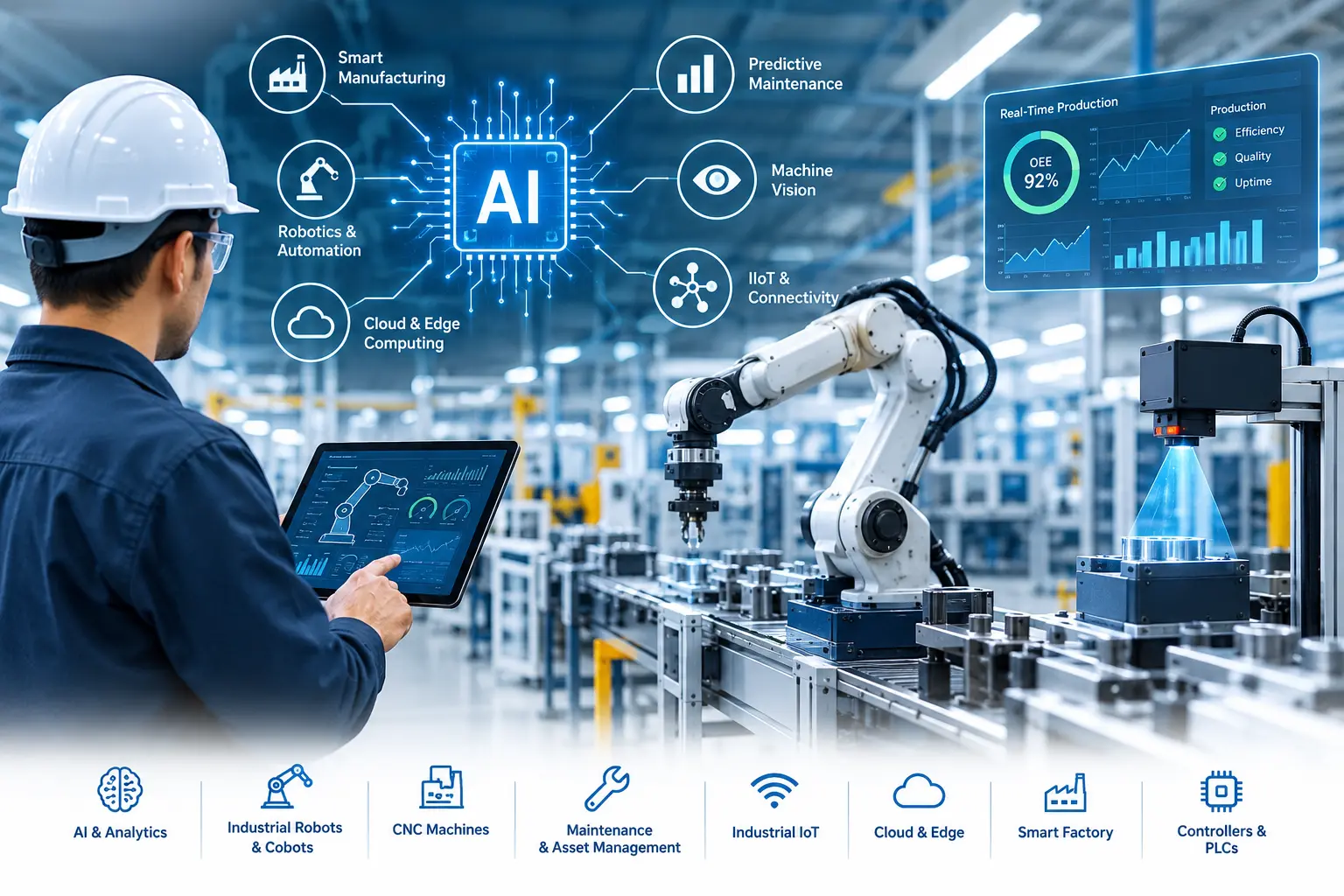
A traditional robotic arm is remarkably capable within a narrow, precisely defined set of conditions, but it has no real understanding of what it is doing. It follows a fixed programmed path, and if a part shows up slightly out of position, oriented differently than expected, or with a subtle variation the program did not anticipate, the arm either fails the task or, worse, damages the part or itself. AI powered robotic arms change this equation by layering perception, adaptive control, and learned decision making on top of the same underlying arm hardware, allowing the robot to handle exactly the kind of variability that has always been the weak point of traditional fixed automation.
This is not a wholesale replacement of robotic arm hardware but an enhancement layer, meaning many of the applications described in this guide can be achieved by adding AI capable vision systems, force sensors, and control software to arms a manufacturer may already own, as well as through newer arms designed with these capabilities built in from the start. This guide walks through exactly what makes a robotic arm AI powered, the specific new capabilities this unlocks, and the applications where this technology is delivering the strongest, most proven results in manufacturing today.
What Actually Makes a Robotic Arm AI Powered
The core arm hardware in an AI powered system is often mechanically similar or even identical to a traditional industrial robot or cobot, meaning the real transformation happens in the perception and control layers added around that hardware. Computer vision systems, often using deep learning models rather than older rule based image processing, allow the arm to see and understand its environment, identifying part location, orientation, and even subtle quality characteristics in real time rather than assuming parts always arrive in a fixed, predictable position. Force and torque sensors integrated into the arm's wrist or gripper allow it to feel how much resistance it is encountering during a task, enabling delicate, adaptive movements that a purely position controlled traditional arm cannot safely perform. Machine learning models processing this sensor data in real time allow the arm to make moment to moment decisions about how to adjust its motion, rather than following a single rigid, pre programmed path regardless of what the sensors are actually detecting.
Key AI Capabilities Being Added to Robotic Arms
Vision Guided Grasping
Rather than requiring parts to be precisely positioned by a fixture before the arm can reliably pick them up, vision guided grasping allows the arm to identify a part's exact position and orientation from a camera image and calculate an appropriate grasp point in real time, dramatically reducing the need for expensive, precise part positioning infrastructure.
Force and Torque Adaptive Control
Adding force and torque feedback allows an arm to perform tasks requiring a delicate touch, such as inserting a component into a tightly toleranced opening or applying consistent pressure during a polishing operation, adjusting its motion in real time based on the resistance it actually encounters rather than following a fixed motion profile that assumes perfectly consistent conditions every time.
Defect Aware Processing
Some AI powered arms integrate quality inspection directly into the manipulation task itself, using onboard or nearby vision systems to identify defects on a part as the arm handles it, allowing the system to sort, reject, or flag defective parts as an integrated part of the material handling process rather than requiring a completely separate inspection station.
Generative and Adaptive Motion Planning
Advanced AI powered systems can generate an appropriate motion path in real time based on the specific obstacles and part positions currently present in the workspace, rather than relying on a single pre programmed path that assumes an unchanging, static environment, allowing the arm to navigate around unexpected obstructions or adjust its approach angle based on how a specific part happens to be positioned.
Natural Language and Simplified Programming
An increasing number of AI powered arm systems allow operators to describe a desired task in plain language or through simple demonstration, with the underlying AI translating that description or demonstration into the detailed motion and grasping parameters needed to actually execute the task, significantly reducing the specialized robotics programming expertise traditionally required to deploy or reconfigure an arm for a new job.
Traditional Programmed Arms vs AI-Powered Arms by Capability
| Capability | Traditional Programmed Arm | AI-Powered Arm |
|---|---|---|
| Handling Randomly Positioned Parts | Requires precise fixturing or feeding | Identifies and adapts to actual part position |
| Delicate or Variable Force Tasks | Limited, follows fixed motion regardless of resistance | Adjusts force and motion based on real time feedback |
| Handling Product Variation | Struggles, often requires reprogramming | Generalizes across reasonable natural variation |
| Setup for a New Task | Manual programming by a specialist | Faster, often via demonstration or simple configuration |
| Recovering From Unexpected Conditions | Typically stops and requires human intervention | Can often adapt or attempt an alternative approach |
The Best Applications for AI-Powered Robotic Arms Today
Adaptive Bin Picking
Picking individual parts out of a bin where they arrive randomly oriented and jumbled together has always been one of the most difficult tasks for traditional fixed automation, since precisely programming a path to grasp a part in an unpredictable position is essentially impossible. AI powered arms using vision guided grasping have become genuinely reliable at this task, identifying an appropriate grasp point on whichever part happens to be accessible at the top of the pile and adjusting their approach in real time, making this one of the most mature and widely proven AI robotic arm applications in manufacturing today.
Flexible Assembly With Variable Tolerances
Assembly tasks involving components with natural manufacturing variation, such as inserting a cable connector or fastener into an opening with slightly inconsistent tolerances from one unit to the next, benefit enormously from force adaptive control, since the arm can feel when it encounters resistance and adjust its insertion angle or force in real time rather than forcing a rigid, pre programmed motion that would either fail or potentially damage the part on units falling outside the expected tolerance range.
Integrated Handling and Quality Inspection
Combining defect aware processing directly into a material handling task allows a single AI powered arm to simultaneously move parts through a process while identifying and sorting out defective units, eliminating the need for a completely separate inspection station and the additional handling steps that would otherwise be required to move parts between a dedicated inspection point and the next process step.
Surface Finishing With Force Feedback
Tasks such as sanding, polishing, or deburring benefit significantly from force adaptive control, since maintaining consistent pressure against a surface, even one with slight variation in shape or hardness, produces a more consistent finish quality than a fixed position controlled motion that cannot sense or adjust to the actual resistance being encountered.
Unstructured Material Handling
Facilities handling incoming raw materials or components that arrive without consistent packaging or orientation, such as recycled materials or irregularly shaped agricultural products, increasingly rely on AI powered vision guided arms to sort and handle this inherently unpredictable material flow, a task category that was essentially inaccessible to traditional fixed automation given its dependence on consistent, predictable part presentation.
Collaborative Tasks With Real Time Human Adaptation
AI powered arms working directly alongside human operators can use vision and force sensing to adjust their behavior based on a human coworker's actual movements and position in real time, enabling more fluid, genuinely collaborative tasks such as an arm adjusting how it presents a part based on exactly where and how a human worker is reaching for it, rather than requiring the human to adapt entirely to a fixed, predictable robot behavior.
Retrofit vs New AI-Native Arm Systems
Manufacturers do not necessarily need to purchase an entirely new robotic arm to gain AI powered capability, since many of the applications described in this guide can be achieved by adding AI capable vision systems, force sensors, and updated control software to an existing traditional arm a manufacturer already owns. This retrofit approach is often considerably more cost effective for manufacturers with existing, mechanically sound arm hardware that simply lacks the perception and adaptive control layer needed for more advanced applications. Newer arms designed as AI native systems from the start typically integrate these sensing and processing capabilities more seamlessly, potentially offering better performance and easier configuration, but at a higher cost than a retrofit approach, making the right choice dependent on whether a manufacturer's existing arm hardware is mechanically well suited to the target application and simply needs the additional AI capability layered on top.
ROI Considerations for AI-Powered Arm Applications
The ROI case for AI powered robotic arm capability is generally strongest for applications that were previously impossible or impractical to automate at all with traditional fixed automation, such as adaptive bin picking or handling unstructured materials, since the alternative in these cases is often continued reliance on manual labor for a task that offers no traditional automation path. For applications where a traditional fixed automation solution already exists and performs adequately, the additional cost of adding AI capability should be weighed specifically against the value of the flexibility and reduced downtime it provides, since a well functioning traditional automated process for a genuinely stable, unchanging task may not need the added cost and complexity of an AI powered upgrade to deliver strong existing ROI.
Industry Examples of AI-Powered Arm Deployment
Electronics manufacturers assembling circuit boards and small devices have adopted AI powered arms extensively for tasks such as flexible connector insertion, where force feedback allows the arm to feel when a connector is properly seated even given the small natural variation present across a batch of components. Automotive parts suppliers producing cast or forged components with natural surface and dimensional variation from one unit to the next use AI powered bin picking arms to sort and feed these components into downstream machining or assembly processes, a task that would require extensive and costly fixturing infrastructure to handle with traditional fixed automation. Consumer goods manufacturers packaging products of slightly varying size or shape, such as fresh produce or irregularly shaped packaged items, increasingly rely on vision guided AI powered arms for pick and place packaging tasks, since the natural variation in these products makes precise, fixed position programming impractical at the speed and volume required for modern packaging lines. Metal fabrication shops performing surface finishing on parts with complex or slightly inconsistent geometry use force adaptive AI powered arms to maintain consistent polishing or deburring pressure across a part's surface, achieving a more uniform finish quality than would be possible with a purely position controlled traditional arm following a fixed motion path.
Building an Internal Data Strategy for AI-Powered Arm Applications
Since AI powered arm systems generally improve their accuracy and reliability as they process more real production data, manufacturers should think proactively about how they capture and use this data rather than treating it as an incidental byproduct of normal operation. Establishing a clear process for reviewing and correcting any grasp failures, quality misclassifications, or other errors the system makes during its early operating period provides exactly the kind of labeled data needed to improve the underlying model's accuracy over time. Manufacturers deploying AI powered arms across multiple similar applications or facilities should also consider whether data and learned improvements from one deployment can be shared to accelerate the performance of similar deployments elsewhere, since a model that has already learned to handle a particular type of part variation at one facility can often be adapted more quickly for a similar application at another location than training an entirely new model from scratch. Building this kind of deliberate data and continuous improvement process around AI powered arm deployments, rather than treating an initial installation as a finished, static project, is often what separates manufacturers who see steadily improving performance over time from those whose AI powered systems plateau at their initial, unrefined accuracy level.
Current Limitations Manufacturers Should Understand
Despite substantial progress, AI powered robotic arms still face real limitations manufacturers should factor into their expectations. Performance can degrade in poor or inconsistent lighting conditions for vision based capabilities, making proper lighting design just as important for an AI powered vision system as it is for traditional machine vision inspection. Extremely high speed applications may still favor traditional fixed automation, since the additional sensing and decision making processing involved in an AI powered system can introduce some latency compared to a purely pre programmed, deterministic motion. Manufacturers should also expect an initial period of data collection and model refinement for the most complex applications, since AI powered systems generally improve their accuracy and reliability as they process more real production data, meaning day one performance on a genuinely novel application may not immediately match the system's eventual, more mature performance level.
Frequently Asked Questions
Can an existing traditional robotic arm be upgraded to AI-powered capability?
In many cases, yes, since adding an AI capable vision system, force and torque sensors, and updated control software to an existing arm can unlock many of the applications described in this guide without requiring a completely new robot, provided the existing arm's mechanical hardware is well suited to the target application.
Which application sees the fastest and most reliable ROI from AI powered arm technology?
Adaptive bin picking is generally considered one of the most mature and reliably successful applications, since it directly addresses a task that has always been essentially impossible for traditional fixed automation to handle well, offering a clear alternative to continued manual labor for that specific task.
Do AI-powered arms require specialized programming expertise to operate?
Many current AI powered arm systems are specifically designed with simplified configuration or demonstration based setup that reduces the need for specialized robotics programming expertise, though the most advanced or highly customized applications may still benefit from some outside integration support during initial deployment.
How does lighting affect AI powered vision guided robotic arm performance?
Lighting quality and consistency significantly affect vision guided arm performance, since poor or highly variable lighting can degrade the accuracy of the underlying computer vision system, making proper lighting design just as critical for an AI powered arm application as it is for any other machine vision system.
Is AI powered arm technology reliable enough for high volume, continuous production?
Many AI powered arm applications, particularly mature use cases such as adaptive bin picking, have demonstrated reliable performance in continuous high volume production, though manufacturers should expect some initial performance ramp up period as the system accumulates real production data, and should evaluate a specific vendor's track record on comparable applications before committing to a large scale deployment.
How much does adding AI capability typically increase the cost compared to a traditional robotic arm?
The added cost varies considerably depending on the specific sensors and software required for a given application, with a straightforward vision guided grasping upgrade generally costing less than a more complex system combining multiple sensor types and advanced adaptive motion planning, making it worthwhile to scope the specific capabilities a task actually requires rather than assuming every application needs the full range of available AI enhancements.
What kind of ongoing support does an AI-powered arm system typically require?
Beyond standard mechanical maintenance similar to any robotic arm, AI powered systems benefit from periodic review of their performance data and occasional model retraining as new product variants or previously unseen conditions are introduced, meaning manufacturers should plan for some ongoing attention to the system's software and data pipeline rather than treating it as a purely mechanical piece of equipment requiring no further oversight after installation.
Final Thoughts
AI powered robotic arms represent a meaningful evolution beyond traditional fixed automation, adding perception, adaptive force control, and learned decision making that allow the same underlying arm hardware to handle exactly the kind of variability and unpredictability that has always limited what robotic automation could reliably achieve. Manufacturers evaluating this technology should focus first on applications genuinely difficult or impossible for traditional automation to handle, such as adaptive bin picking, flexible assembly with natural tolerance variation, and unstructured material handling, where the ROI case is clearest, while approaching more marginal upgrades to already well functioning traditional automated processes with a more careful cost benefit evaluation.