If you are looking for a simple, safe and completely free way to enjoy movies and series on your cell phone, tablet or TV, Tubi – Free Movies and Series stands out as one of the best options available in 2026. With an impressive collection, a clean interface, and support for Portuguese subtitles, the app offers access to thousands of titles free of charge. And best of all, it's available for direct download from the official stores:

Tubi: Free Movies & Live TV
Industrial Automation Trends 2026-27: What Manufacturers Should Invest in Next
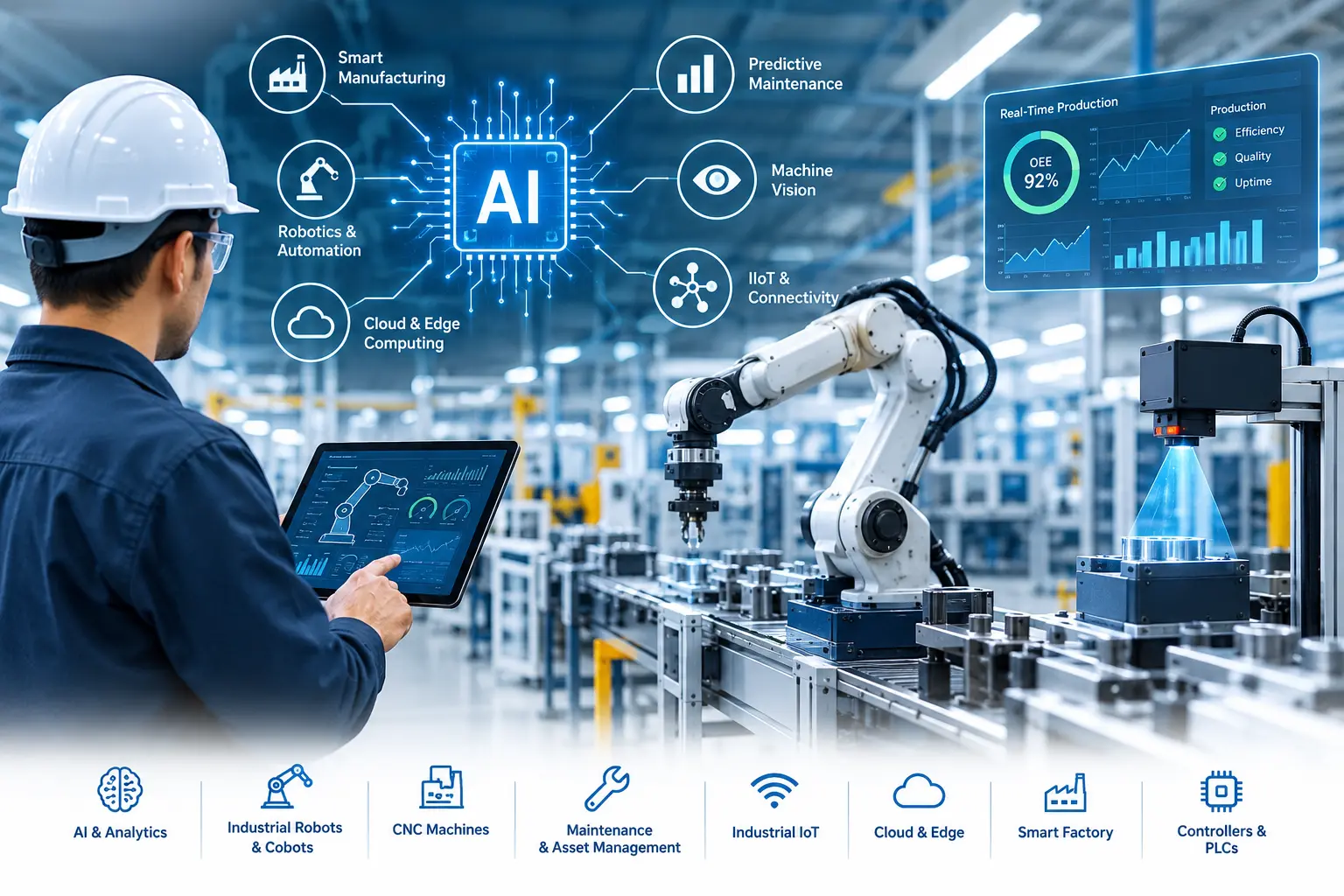
Industrial automation has entered a period of unusually fast change, driven less by any single breakthrough technology and more by a convergence of economic and workforce pressures that are forcing manufacturers to rethink how their plants operate. Persistent shortages of skilled labor, growing pressure to shorten and diversify supply chains, rising energy costs, and rapid maturation of artificial intelligence are all pushing in the same direction at the same time, and the result is a wave of automation investment unlike anything the industry has seen in the past decade.
For manufacturing leaders trying to decide where to place capital over the next two years, understanding which trends represent lasting structural shifts versus which are simply this year's hype cycle is essential. This guide walks through the industrial automation trends most likely to shape 2026 and 2027, the underlying forces driving each one, and practical guidance on where manufacturers should actually focus their next round of investment.
Why 2026-27 Is an Inflection Point for Industrial Automation
Several forces are converging to make this period different from previous automation adoption cycles. Persistent shortages of experienced machine operators, maintenance technicians, and skilled trades workers in many manufacturing regions are making labor saving automation less of an efficiency nice to have and more of an operational necessity, since many manufacturers simply cannot find enough qualified staff to run their operations at full capacity through traditional methods alone. At the same time, ongoing efforts to reshore or nearshore production, driven by supply chain resilience concerns following recent years of disruption, are pushing manufacturers to build new domestic capacity that is automated from the ground up rather than replicating older, more labor intensive production models. Rising and volatile energy costs are adding urgency to efficiency focused automation investments, while continued advances in artificial intelligence, particularly in areas such as generative AI and more capable autonomous decision making systems, are making automation practical for tasks that were previously too variable or judgment dependent to automate cost effectively.
Trend One: Agentic AI Taking on Autonomous Decision Making
Where earlier generations of industrial AI mostly generated recommendations for a human to review and act on, a new generation of agentic AI systems is beginning to take autonomous action within clearly defined boundaries, adjusting process parameters, rescheduling production, or ordering replacement parts without waiting for explicit human approval at every step. This trend is moving fastest in lower risk, well bounded decisions such as routine scheduling adjustments and inventory reordering, while higher risk decisions involving safety or significant capital commitment are likely to retain human oversight for longer, even as the underlying technology continues to mature.
Trend Two: Flexible and Modular Automation for Mass Customization
As customer demand shifts toward greater product personalization and shorter product lifecycles, manufacturers are investing in modular automation systems that can be reconfigured quickly for new products rather than the traditional fixed, single purpose automation lines of the past. This includes modular robotic cells that can be physically rearranged, software defined production lines where changeovers are handled through configuration rather than mechanical rework, and increased use of AI driven vision and adaptive control systems that reduce the need for extensive reprogramming every time a product variant changes.
Trend Three: Reshoring-Driven Greenfield Automation Investment
Manufacturers building new domestic production capacity as part of broader reshoring or supply chain diversification efforts are overwhelmingly designing these new facilities around a much higher baseline level of automation than older, legacy plants, since new construction offers a rare opportunity to build automation and connectivity infrastructure into the facility from day one rather than retrofitting it onto existing equipment. This is accelerating adoption of technologies such as autonomous mobile robots, integrated manufacturing execution systems, and AI powered quality inspection well beyond what has traditionally been standard for a plant's first year of operation.
Trend Four: Humanoid and Advanced Mobile Robotics Entering Real Production Trials
General purpose humanoid robots, designed to operate in environments built for human workers without extensive facility redesign, are moving from research demonstrations into early production trials at a small number of manufacturers, particularly for tasks involving material handling and simple assembly in facilities not easily retrofitted with fixed automation. While widespread commercial deployment remains limited and costs are still relatively high compared to more established automation categories, manufacturers should monitor this space closely, since the technology is advancing quickly and could become commercially competitive for specific applications sooner than many currently expect.
Trend Five: Sustainability and Energy Efficiency as a Core Automation Driver
Automation investment decisions are increasingly being evaluated not just on labor and quality impact, but on their contribution to energy efficiency and emissions reduction, driven by both rising energy costs and growing regulatory and customer pressure around environmental reporting. This is pushing manufacturers toward AI driven energy management systems, more efficient motor and drive technology, and process optimization software that reduces material waste alongside its traditional efficiency and quality benefits.
Trend Six: Robotics and Automation as a Service
Rather than purchasing automation equipment outright, a growing number of manufacturers, particularly smaller and mid size operations, are adopting subscription based robotics and automation as a service models, where hardware, software, and maintenance are bundled into a recurring payment tied to usage or performance. This lowers the upfront capital barrier to automation adoption considerably and shifts more of the implementation and maintenance risk onto the vendor, making advanced automation accessible to manufacturers who previously could not justify the large upfront capital expenditure required to purchase equivalent equipment outright.
Trend Seven: Interoperability and Open Industrial Data Standards
As manufacturers connect more machines, sensors, and software platforms from different vendors, the historical lack of interoperability between industrial systems has become an increasingly visible bottleneck, and the industry is responding with growing adoption of open data standards and communication protocols designed specifically for industrial environments. This trend is making it progressively easier for manufacturers to mix and match best of breed solutions from different vendors, rather than being locked into a single vendor's complete, closed ecosystem for their entire automation stack.
Trend Eight: Workforce Upskilling Programs Built Around Automation
As automation takes over more repetitive and physically demanding tasks, manufacturers are investing heavily in structured training programs designed to shift their existing workforce toward roles overseeing, maintaining, and improving automated systems rather than performing the tasks those systems now handle. This includes partnerships with technical colleges and community training programs, internal apprenticeship style programs pairing experienced staff with newer employees, and increasing use of augmented reality and simulation tools that let workers practice with new equipment before it goes live in production.
Trends and Their Underlying Drivers
| Trend | Primary Driving Force |
|---|---|
| Agentic AI decision making | Maturing AI models and growing trust in automated recommendations |
| Flexible and modular automation | Rising demand for product customization and shorter product cycles |
| Reshoring driven greenfield automation | Supply chain diversification and domestic capacity expansion |
| Humanoid and advanced mobile robotics | Persistent labor shortages in flexible material handling tasks |
| Sustainability driven automation | Rising energy costs and environmental reporting requirements |
| Robotics and automation as a service | Lower barrier to entry for smaller manufacturers |
| Interoperability and open standards | Growing complexity of multi vendor automation ecosystems |
| Workforce upskilling programs | Shifting labor demand toward oversight and technical roles |
What Manufacturers Should Actually Invest in Next
Given this wide range of trends, manufacturers need a clear filter for deciding what to prioritize rather than attempting to chase every emerging technology simultaneously. For most manufacturers, the most defensible next investment is one that directly addresses a currently painful, well quantified problem, such as chronic difficulty staffing a specific shift or task, a persistent quality issue, or an energy cost that has become disproportionately large relative to output. Manufacturers planning new facility construction or a major expansion should weigh reshoring driven greenfield automation trends carefully, since building in higher baseline automation and connectivity from the outset is almost always cheaper than retrofitting it later. For manufacturers with tighter capital constraints, automation as a service models are worth serious evaluation, since they can provide access to advanced automation capability without the large upfront capital commitment that has historically excluded smaller operations from these technologies. Regardless of which specific technology a manufacturer prioritizes, investing in interoperable systems built on open standards, and in workforce training that prepares staff for an increasingly automated environment, will pay dividends across every future automation investment the organization makes.
The Risk of Waiting Too Long to Invest
While it is reasonable to be cautious about chasing every emerging trend, manufacturers should also weigh the competitive risk of moving too slowly during a period when automation adoption is accelerating industry wide. Competitors who successfully address chronic labor shortages through automation gain a meaningful operational advantage that becomes progressively harder to close the longer it persists, since automated processes tend to compound their advantage through accumulated data, refined models, and organizational experience that a late adopter cannot simply purchase and replicate overnight. Manufacturers that delay foundational investments such as basic connectivity and workforce upskilling risk finding themselves unable to adopt more advanced technologies later, since these foundational capabilities are prerequisites for effectively deploying the more sophisticated automation trends described above.
Trend Nine: Edge AI Proliferation Across Legacy Equipment
Falling costs and rapidly improving performance of edge computing hardware are making it practical to run increasingly sophisticated AI models directly on or near legacy machinery, rather than depending on cloud connectivity for every inference decision. This trend is particularly important for manufacturers with older facilities that lack robust network infrastructure, since edge AI allows advanced capabilities such as real time defect detection and adaptive process control to function reliably even in environments where consistent high bandwidth connectivity to a central cloud platform is not yet available. As edge hardware continues to improve, expect an increasing share of AI workloads that previously required cloud processing to move closer to the machine itself, reducing latency and improving resilience against network outages.
Trend Ten: Generative AI Reshaping Engineering and Process Design Work
Beyond its growing role in production scheduling and natural language interfaces, generative AI is beginning to reshape upstream engineering work such as designing new tooling, generating process documentation, and rapidly exploring alternative production line layouts. Engineers are using these tools to accelerate the early stages of process design, generating multiple candidate approaches to a manufacturing challenge in a fraction of the time traditional manual design work would require, then applying their own expertise to evaluate and refine the most promising options. This trend is expected to compress the time between identifying a new production need and having a validated process design ready for implementation, though human engineering judgment remains essential for validating that AI generated designs actually meet real world safety, quality, and manufacturability requirements.
How These Trends Interact With Existing Automation Investments
None of these trends exist in isolation, and manufacturers should think carefully about how a new investment will interact with automation systems already in place. A facility that has already invested heavily in basic connectivity and a manufacturing execution system is far better positioned to take advantage of agentic AI decision making and generative AI engineering tools than one still relying on manual data collection and paper based processes, since these more advanced capabilities depend on having reliable, well structured data flowing continuously from the plant floor. Similarly, manufacturers considering robotics as a service arrangements should evaluate how easily that vendor's platform will integrate with existing systems, since a technically impressive robotic solution that cannot share data with the rest of the plant's automation ecosystem delivers considerably less value than one that can. This interdependence is exactly why foundational investments in connectivity and interoperability, discussed earlier in this guide, tend to increase the return on nearly every other automation trend a manufacturer eventually decides to pursue.
Regional Variation in How These Trends Are Playing Out
While the trends described in this guide are broadly global, the pace and specific emphasis of adoption varies considerably by region, and manufacturers should factor this into their own planning rather than assuming a uniform global picture. Regions experiencing the most acute skilled labor shortages tend to see the fastest adoption of labor replacing technologies such as autonomous mobile robots and cobots, while regions with strong existing manufacturing labor pools but higher energy costs tend to prioritize energy efficiency driven automation investments instead. Government incentive programs supporting domestic manufacturing capacity also vary significantly by country and even by state or province within a country, meaning the relative attractiveness of reshoring driven greenfield automation investment can differ substantially depending on where a manufacturer is considering expanding. Manufacturers operating across multiple regions should resist applying a single automation strategy uniformly across every facility, and instead tailor their investment priorities to the specific labor market, energy cost, and incentive environment each individual plant actually faces.
Preparing the Organization, Not Just the Technology
Even the most promising automation trend will underdeliver if an organization is not structurally prepared to adopt it. Manufacturers pursuing several of these trends simultaneously should ensure they have a clear internal governance process for evaluating and prioritizing automation investments, rather than allowing individual departments to pursue disconnected pilot projects that never scale into an integrated automation strategy. Building cross functional teams that include operations, IT, and finance perspectives early in the evaluation process helps ensure that promising technologies are assessed not just on their technical merit, but on how realistically they can be integrated, secured, and financially justified within the organization's actual operating constraints. Manufacturers that treat automation strategy as an ongoing organizational capability, revisited and refined regularly as new trends emerge, consistently outperform those that treat each new technology as an isolated, one time purchasing decision disconnected from a broader long term plan.
Frequently Asked Questions
Which of these trends is most likely to affect smaller manufacturers first?
Robotics and automation as a service models are likely to have the most immediate impact on smaller manufacturers, since they remove the large upfront capital barrier that has historically limited advanced automation adoption to larger, better capitalized operations.
Is agentic AI safe to use for autonomous decision making in a factory?
Current agentic AI deployments in manufacturing are generally limited to lower risk, well bounded decisions such as scheduling adjustments and inventory reordering, with higher risk decisions involving safety or significant capital commitment still retaining human oversight in most current deployments.
Should manufacturers wait for humanoid robots to mature before investing in automation?
Most manufacturers should continue investing in already proven automation categories such as predictive maintenance, AI vision inspection, and autonomous mobile robots rather than waiting for humanoid robotics to reach broader commercial viability, since these established technologies already deliver reliable, well understood returns today.
How does reshoring actually change automation investment decisions?
Reshoring encourages manufacturers to build automation and connectivity infrastructure into new facilities from the initial design phase, generally resulting in a higher baseline level of automation than would typically be found in an older facility that has only gradually added automation over many years.
What is the biggest risk of moving too slowly on these trends?
The biggest risk is falling behind competitors who successfully address labor shortages and efficiency challenges through earlier automation adoption, since automated systems tend to compound their advantage over time through accumulated data and organizational experience that becomes progressively harder for a late adopter to replicate quickly.
How should a manufacturer decide between multiple competing trends with limited budget?
The most reliable approach is to rank each candidate investment against a specific, currently quantified operational problem the organization already faces, such as a chronic staffing gap or a disproportionately high energy cost, rather than prioritizing based on how much industry attention a particular trend is currently receiving.
How to Future-Proof an Automation Investment Decision
Given how quickly some of these trends are still evolving, manufacturers reasonably worry about committing capital to a technology approach that could be outdated within a few years. A few practical principles help reduce this risk without requiring leadership to simply wait on the sidelines. Favoring modular, standards based systems over deeply proprietary, closed platforms preserves flexibility to adopt future capabilities without a complete rip and replace of existing infrastructure. Prioritizing investments that generate reusable data and organizational capability, such as connectivity and workforce training, over narrowly scoped point solutions tied to a single current technology trend also tends to age better, since that underlying capability remains valuable even as the specific tools built on top of it evolve. Finally, building contractual flexibility into vendor agreements, including reasonable exit terms and data portability rights, ensures that a manufacturer is not locked into a specific approach to a fast moving trend longer than the technology itself remains genuinely competitive.
Final Thoughts
The industrial automation trends shaping 2026 and 2027 are being driven less by any single dramatic technology breakthrough and more by a convergence of labor, supply chain, and energy pressures that are making automation an operational necessity rather than an optional efficiency project. Manufacturers who succeed over the next two years will be the ones who resist chasing every emerging trend indiscriminately, and instead invest deliberately in the technologies that address their specific, well understood operational challenges, while still building the foundational connectivity, interoperability, and workforce capability needed to adopt whatever comes next.